National Cost Floor
$2.340 / miATRI average marginal carrier operating cost across combined linehaul and regional operations ($1.85/mi non-fuel baseline).
 BLUE BLOODHOUNDOWNER-OPERATOR FIELD INTELLIGENCE Search
Operating a commercial Class 8 semi truck as an independent business is not an employment raise; it is an asset-intensive capital enterprise. A freight rate is not profit until loaded linehaul, unpaid deadhead, equipment debt, commercial insurance, preventative maintenance reserves, and the 15.3% self-employment tax are fully funded. This report synthesizes verified motor carrier telemetry from ATRI, ATBS, FMCSA, and the EIA into an operating intelligence roadmap for U.S. owner-operators.
ATRI average marginal carrier operating cost across combined linehaul and regional operations ($1.85/mi non-fuel baseline).
ATBS 2025 independent contractor benchmark after equipment debt, diesel fuel, and preventative maintenance.
Mandatory FICA payroll tax burden on 92.35% of Schedule C net earnings before income taxes.
Average solo OTR empty repositioning miles eroding headline gross revenue and billable linehaul.
Every spot market load offer is an unverified number until measured against your audited all-mile operating floor. Operating without a documented cost per mile leads to cash insolvency because unloaded deadhead miles, equipment financing, and maintenance reserves consume revenue before owner compensation is funded.
The single largest cost. Hauling under operating cost plus driver pay means working for free.
15,385 gallons burned annually. A 0.5 MPG loss drains $4,200 straight from net cash flow.
A relentless $2,916/month debt clock that never pauses when freight softens or weather strikes.
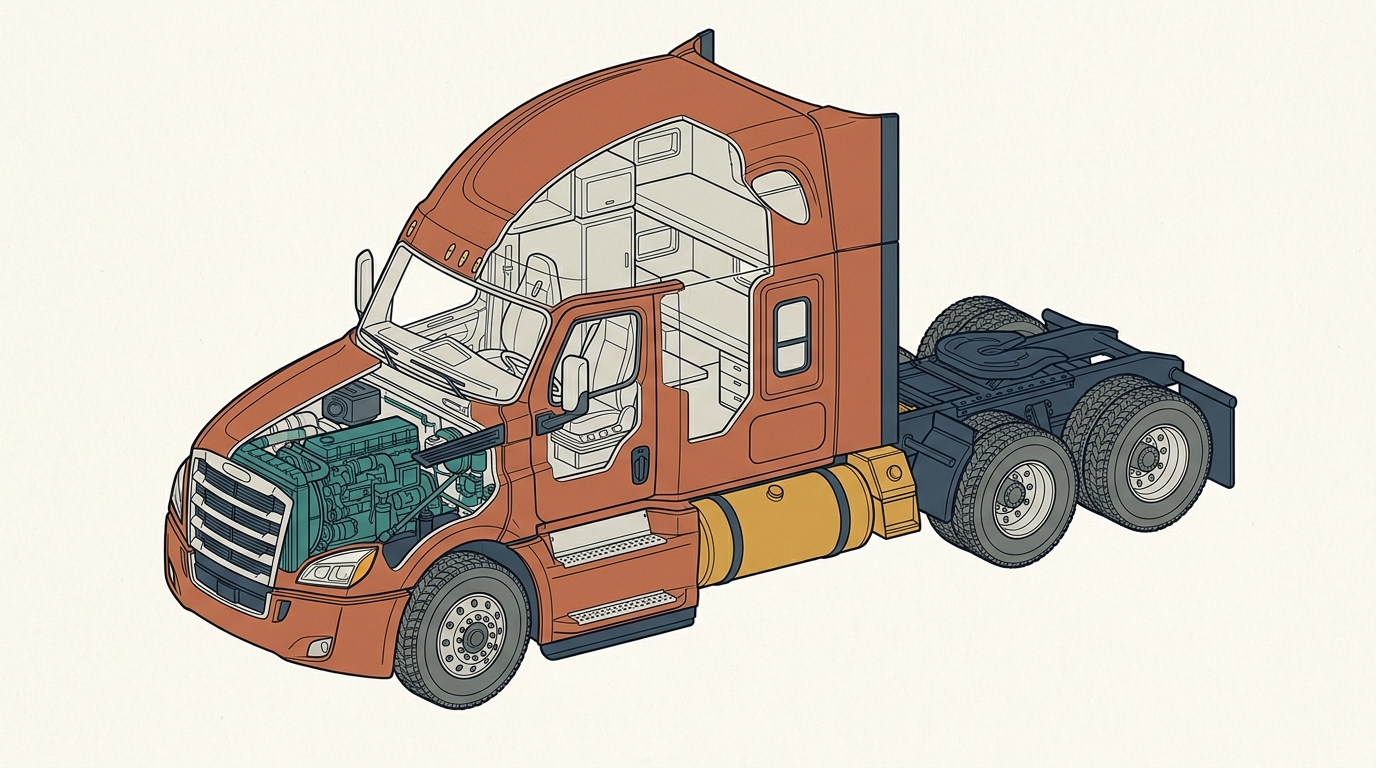
At $32,000 per engine rebuild, carriers without dedicated escrow fail on their first head gasket.
Commercial liability, ELD subscriptions, IRP plates, and federal compliance mandates.
10 PSI under-inflation burns 1% extra fuel and destroys tire casings for future retreading.
Ongoing weekly owner draw / payroll
Never bid below your personal W-2 wage equivalent. If a load pays less than operating expenses plus $0.78/mi, you are donating your driving labor for free while bearing 100% of the equipment risk.
| Expense Category | Classification | Cost / Mile | Annualized (100k mi) | Cost Share | Operating Vulnerability |
|---|---|---|---|---|---|
| Driver Compensation Floor | Driver Pay | $0.78/mi | $78,000 | 33.3% | Ongoing weekly owner draw / payroll |
| Dual Saddle Fuel Tanks & DEF | Fuel & Fluids | $0.55/mi | $55,000 | 23.5% | 15,385 gallons / 100k miles (6.5 MPG baseline) |
| Sleeper Cab Chassis & Debt Note | Equipment Financing | $0.35/mi | $35,000 | 15% | $2,200 – $2,900 / month commercial equipment debt |
| Powertrain & Overhaul Escrow | Maintenance | $0.20/mi | $20,000 | 8.5% | PM every 25,000 mi · In-frame engine rebuild at 600k mi ($28k–$36k) |
| Regulatory Overhead & Insurance | Fixed Overhead | $0.41/mi | $41,000 | 17.5% | ELD monthly subscription + Annual Auto Liability renewal ($14k+) |
| 18-Wheel Tire Tread Lifecycle | Tires | $0.05/mi | $5,000 | 2.1% | Steers: 100k mi · Drives: 250k–350k mi · Trailer: 200k mi |
| TOTAL OPERATING BASELINE FLOOR | $2.34/mi | $234,000 | 100.0% | Minimum survival floor before business net profit | |
Driver wages ($0.65/mi) and benefits ($0.13/mi) combine to form the largest single operating cost at $0.780/mile.
Fuel consumes 23.5% ($0.55/mi) of gross revenue based on 6.5 MPG and 100,000 annual operational miles.
Tractor and trailer monthly notes average $35,000 annually ($0.35/mi), requiring disciplined utilization.
A minimum of $0.25/mi ($25,000/yr) must be escrowed for preventative maintenance, tires, and major component overhauls.
The first fundamental operating decision in commercial trucking is whose authority the freight moves under. That choice dictates your startup capital requirements, commercial insurance burden, freight autonomy, and who retains gross revenues.
| Operating Dimension | Company Driver (W-2) | Leased-On Owner-Operator (1099) | Own-Authority Motor Carrier |
|---|---|---|---|
| Capital Entry Runway | $0 out-of-pocket | $10,000 – $25,000 cash reserve | $35,000 – $60,000 operating capital |
| Tractor & Trailer | Carrier supplied & maintained | Operator owns/leases tractor; carrier trailer | Operator owns/leases tractor and trailer |
| Operating Authority | Carrier MC/USDOT | Carrier MC/USDOT | Operator’s own MC/USDOT number |
| Commercial Insurance | Carrier corporate policy | Non-trucking (bobtail) + physical damage | Primary auto liability ($750k–$1M) + cargo |
| Freight Sourcing | Assigned by fleet dispatch | Carrier load board or internal dispatch | Spot load boards, freight brokers, direct shippers |
| Revenue Retention | Hourly wage or mileage pay | 65% to 85% of load revenue | 100% of load gross linehaul |
| Operating Expenses | Carrier pays fuel, tires, repairs | Operator pays fuel, tractor note, maintenance | Operator pays all operating, legal & administrative costs |
| Tax Structure | W-2 employee (7.65% FICA tax) | 1099-NEC Schedule C (15.3% SE tax) | 1099 Schedule C or S-Corp (15.3% SE tax) |
| Compliance Responsibility | Carrier compliance department | Shared (driver logs + equipment inspection) | 100% carrier audits, Clearinghouse & records |
For full tax deductions and wage parity analysis, review the Company Driver vs. Owner-Operator Guide and our review of 1099 Independent Contractor Agreements.
Launching an independent motor carrier requires navigating strict federal regulatory gates, capital planning, insurance placement, and cash-flow architecture. Premier Truck’s commercial dealer start-up research documents a 60-to-90-day runway to launch under your own authority.
Calculate your personal and business cost floor before buying iron. Ensure you have at least 90 days of personal living expenses plus $20,000 in liquid capital to survive 30-to-60-day invoice payment lags.
Maintain an unblemished CDL Class A with tank and hazmat endorsements to maximize freight flexibility. Ensure your DOT medical card is registered with your state driver licensing agency (SDLA).
Form an LLC or corporation through your Secretary of State to separate personal assets from commercial liability. Obtain an IRS Employer Identification Number (EIN) and establish dedicated commercial bank accounts.
Register for interstate operating authority via the FMCSA Motus system ($300 statutory fee). The FMCSA mandates a 21-day public protest period during which commercial insurance must be filed.
Secure $750,000 public liability (FMCSA regulatory minimum, though $1,000,000 is required by 98% of freight brokers) plus $100,000 motor truck cargo and physical damage coverage.
Source a late-model Class 8 sleeper tractor and 53ft dry van or flatbed trailer. Mandate an independent ECM engine download, oil sample analysis, and dyno test before signing debt instruments.
Register under the Unified Carrier Registration (UCR), set up your International Registration Plan (IRP) cab card, apply for an International Fuel Tax Agreement (IFTA) license, and obtain state highway permits (NY HUT, KYU, OR, NM).
Enroll in an FMCSA-compliant random drug and alcohol testing consortium (C/TPA), register as both employer and driver in the Clearinghouse, and install a self-certified Electronic Logging Device.
Subscribe to primary load board networks (DAT One, Truckstop) and establish carrier packets with reputable freight brokerages. Always check credit ratings and average days-to-pay before booking.
Establish a commercial fuel card program for network pump discounts and evaluate non-recourse invoice factoring lines to maintain steady working capital across your first 90 days of live freight.
Every operational decision begins with verified math. Use these free planning calculators to uncover hidden deadhead penalties, model fuel price volatility, calculate factoring APR equivalents, and establish an unshakeable rate floor.
Turn monthly fixed debts and per-mile variable expenses into your audited rate floor before accepting spot loads.
Normalize broker spot offers across loaded transit and unpaid deadhead miles to calculate true all-in revenue per mile.
Model how monthly mileage utilization spreads fixed equipment debt and insurance overhead across real odometer miles.
Calculate estimated net profit, trip fuel burn, preventative maintenance deductions, and daily earnings before dispatch.
Translate nominal factoring fee percentages into annualized cost of capital (APR) and evaluate net invoice proceeds.
Model required diesel gallons, trip fuel expenditures, and net fuel cost per mile from distance, MPG, and stop prices.
Compare a 5%–10% professional dispatch fee against self-dispatch load board subscriptions and booking time.
Gross linehaul revenue is what the truck billed before the business paid for the move. Solvency is dictated by the interaction between utilization, deadhead, fixed debt dilution, and cash velocity.
Brokers quote rates based strictly on billable loaded miles. However, your truck burns diesel fuel, consumes tire tread, and incurs equipment depreciation on every single revolution of the odometer. Formula: Gross Pay ÷ (Loaded Miles + Origin Deadhead + Repositioning Miles). A $3.00/mile loaded offer on 500 miles collapses to $2.30/mile all-in if you deadhead 150 miles to the shipper.
Fixed expenses (truck payment, insurance premiums, software, parking) do not decrease when your truck sits idle. At 5,000 miles per month, a $4,500 fixed overhead contributes $0.90 per mile. At 10,000 miles per month, that same overhead drops to $0.45 per mile. Diluting fixed debt across realistic mileage is the foundation of competitive bidding.
Cash break-even covers checks written this week: diesel, DEF, and loan installments. Economic break-even accounts for future liabilities: tire casing wear, major component overhaul escrows (at least $0.15–$0.20/mile), and self-employment tax. Pricing freight based only on cash break-even guarantees insolvency when an in-frame engine overhaul strikes.
The number of days between delivering a signed bill of lading (BOL) and having usable cash cleared in your operating account. While standard broker credit terms pay in 30 to 45 days, quick-pay (1%–3%) and invoice factoring lines advance 90% upfront. Understanding factoring APR prevents cash flow crunches from draining net profits.
Explore our comprehensive, source-backed editorial guides covering the primary workflows of running a commercial trucking business.
Compare DAT One, Truckstop, and free freight boards. Verify broker credit and days to pay before booking.
Read comprehensive guide →CASH FLOW MANAGEMENTUnderstand advance rates, UCC-1 blanket liens, recourse clauses, and true annualized APR equivalents.
Read comprehensive guide →SAFETY & REGULATORYNavigate the New Entrant Safety Audit, FMCSA Clearinghouse, DQF files, and recurring biennial MCS-150 updates.
Read comprehensive guide →RISK & ASSET DEFENSEAnalyze primary liability, physical damage, cargo, and bobtail filings. Lower premiums across years 1 to 3.
Read comprehensive guide →COST CONTROLEvaluate retail-minus and cost-plus fuel networks. Reconcile quarterly IFTA taxes from itemized statements.
Read comprehensive guide →FINANCIAL INTELLIGENCEMaximize the $80/day IRS per diem deduction, track actual Class 8 expenses, and avoid quarterly tax penalties.
Read comprehensive guide →Verified, source-backed answers to the most consequential operational and financial questions.
An owner-operator is a self-employed commercial truck driver who owns or leases their tractor and operates it as an independent business. Owner-operators operate under one of two core models: (1) Leased-on to a motor carrier, hauling under the carrier’s operating authority and safety program; or (2) Operating under their own authority as a licensed motor carrier registered with the FMCSA (holding an active USDOT and MC number).
According to ATBS financial benchmark studies covering thousands of independent contractors, average net income for single-truck owner-operators is approximately $71,800 annually on 95,000 operational miles. Gross revenue typically ranges from $180,000 to $260,000, but diesel fuel ($50,000–$65,000), equipment debt ($30,000–$45,000), maintenance reserves ($15,000–$22,000), and insurance ($10,000–$18,000) consume the majority of gross billings.
Becoming an owner-operator is financially viable only when the carrier operates with disciplined cost accounting, low equipment debt, and strong fuel management. In soft freight markets, spot rates frequently dip below the industry average $2.34/mile marginal operating floor. Operators who lack 90 days of cash reserves or haul cheap freight to pay equipment notes face severe insolvency risk. Running conservative cost-per-mile and break-even models is mandatory before transitioning from a company driver seat.
A leased-on owner-operator hauls freight under an established carrier’s USDOT and MC authority, utilizing the carrier’s primary auto liability insurance, safety department, and freight contracts in exchange for a percentage of load revenue (typically 65% to 85% settlement). An own-authority operator is an independent motor carrier who keeps 100% of gross linehaul, sources their own freight through brokers and load boards, purchases their own commercial insurance, and carries direct legal responsibility for FMCSA compliance audits.
Starting an independent own-authority trucking business requires $35,000 to $60,000 in liquid capital. This covers equipment down payments ($10,000–$25,000), insurance down payments ($3,000–$6,000), authority filings, IRP plates, and IFTA credentials ($2,500–$4,500), and provides a mandatory $20,000 working capital reserve for fuel, maintenance, and slow broker payments during the first 60 days.
Based on ATRI operational cost benchmarks, industry average marginal operating costs sit at approximately $2.34 per mile ($1.85/mile excluding fuel). For single-truck independent owner-operators with older equipment and higher first-year insurance premiums, realistic cost-per-mile floors range between $2.00 and $2.55 per mile across all odometer miles (including empty deadhead).
Owner-operators source freight through three primary channels: (1) Digital spot load boards such as DAT One and Truckstop, which list hundreds of thousands of daily broker loads; (2) Direct relationships with 3PLs and freight brokerages that offer dedicated lane contracts; and (3) Direct shipper freight, which requires sales outreach and cargo insurance guarantees but bypasses broker margins.
Yes. All seven Blue Bloodhound calculators (including the Cost per Mile Calculator, Rate per Mile Calculator, Break-Even Analyzer, and Factoring APR Calculator) are completely free planning tools provided for commercial motor carriers and drivers. Calculations are generated transparently in your browser without paywalls or forced registration.
Sourced telemetry, government regulations, provider claims, and editorial judgment are strictly separated. Our recommendations name the operating fit, the underlying calculations, and the operational tradeoffs.